What to Ask in a Celtic Cross Spread (and What Not To)
Not all questions work equally well in a 10-card spread. The Celtic Cross gives more when the question has enough depth to justify its ten positions. Here is which questions work and how to formulate them.
Why the question matters so much in a Celtic Cross
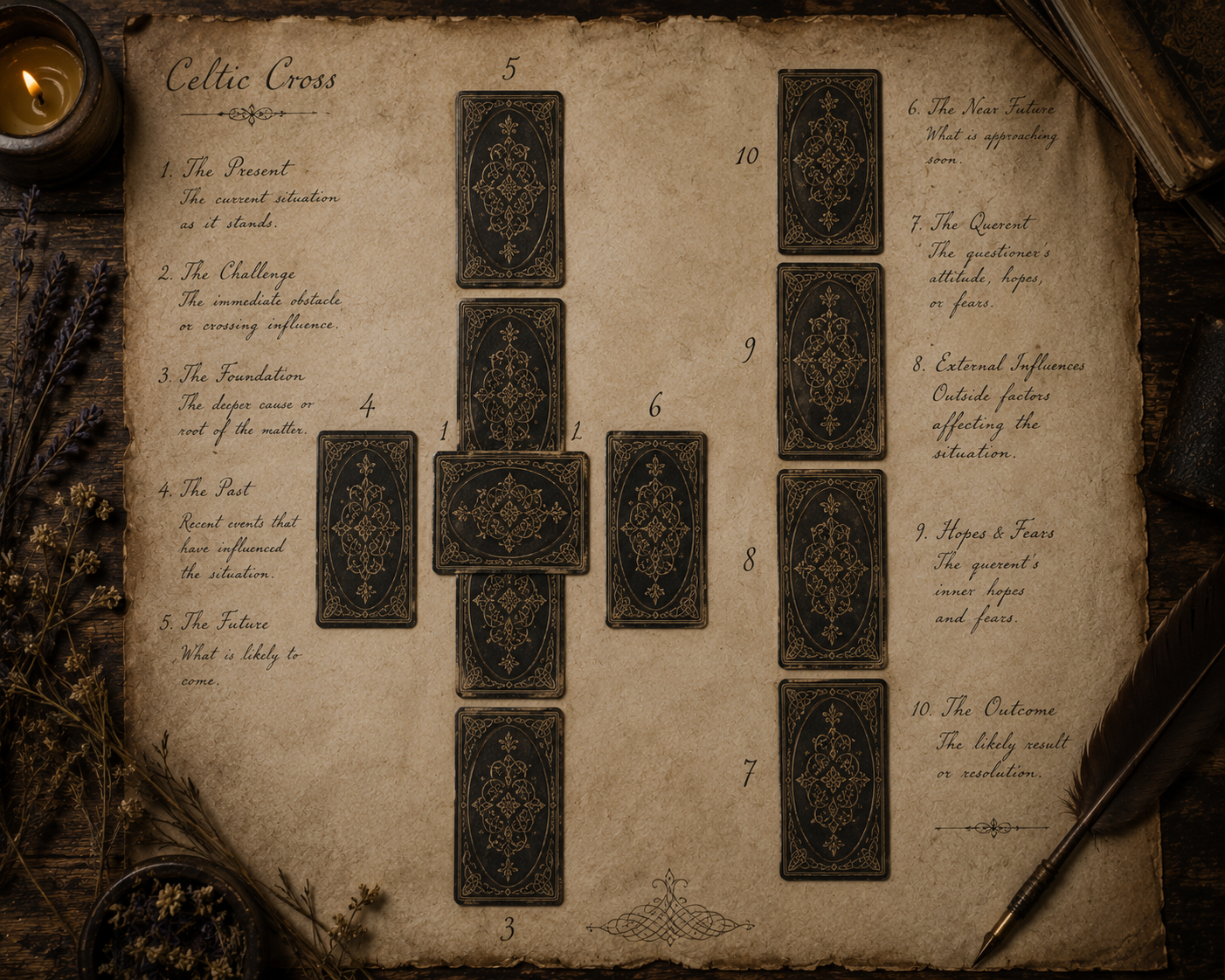
The Celtic Cross is a 10-card spread that covers the present, past, future, blocks, external influences, hopes, and likely outcome. With so much information laid out, the quality of the opening question determines whether the reading gives you real clarity or just a lot of loose data. A good question focuses the entire spread.
The best types of questions for a 10-card spread
Questions that work best in a Celtic Cross are those exploring a complex situation with multiple dimensions: a relationship that has not defined itself, a work decision with many variables, a personal process you have been stuck on for a long time. The question needs enough depth to justify 10 reading positions.
Examples of questions that use the Celtic Cross well
Good questions: What do I need to know about my relationship with X right now?, What is at the root of my current work situation?, What is blocking my progress in this project and what can I do about it? These questions open space for the 10 positions to provide complementary rather than redundant information.
Request your Celtic Cross with a well-framed question
10 cards, full interpretation, synthesis and final counsel.
Get my Celtic CrossQuestions that waste a Celtic Cross
Questions like Will my ex come back? or Will they call me tomorrow? do not justify 10 positions. For binary answers, yes-or-no tarot is more efficient. For immediate orientation, a 3-card spread is enough. Asking for a Celtic Cross for a simple question is like hiring an architect to hang a picture frame.
How to formulate your question before the spread
Before requesting the spread, write the question down. Read it out loud. If the answer could be yes or no, rephrase it to be more open. If it mentions more than one person or includes more than one situation, simplify it to focus on one main topic. A well-formulated question makes the interpretation more precise and useful.
Cards in your inbox, every Monday.
Straight weekly orientation, no filler.