What your natal birth chart reading includes: 5 levels of analysis
A personalized birth chart is not a list of planetary positions. This is exactly what the astrologer analyzes and what you receive in the reading.
The data you need to generate your natal chart
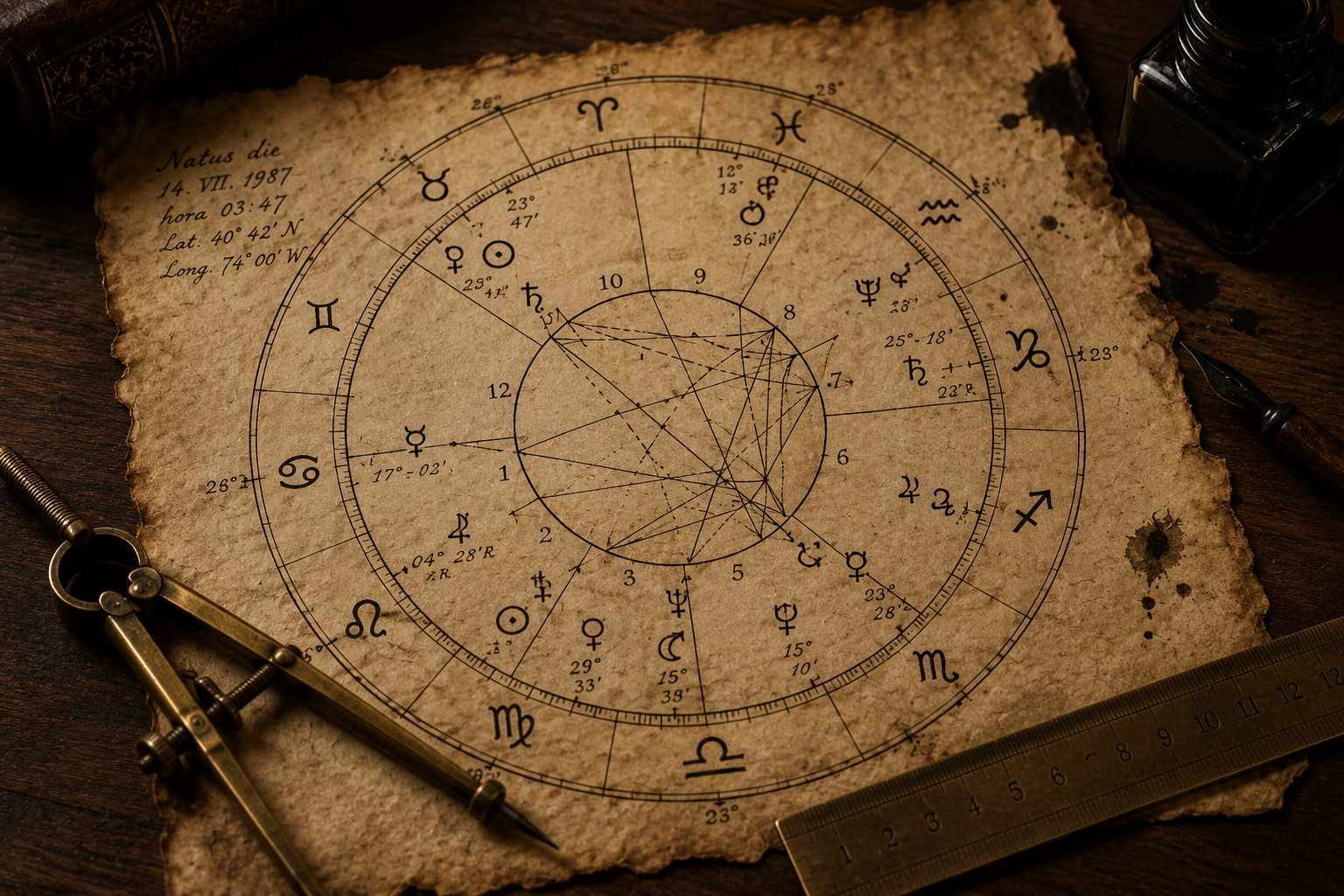
To calculate a natal chart you need three pieces of data: birth date, exact birth time, and place of birth. Birth time is the most critical because it determines the Ascendant and the position of the astrological houses. A 15-minute error can change the entire Ascendant. If you do not know your exact birth time, the chart can be calculated with rectification or using noon as a reference, though precision is lost in house analysis.
The 5 analysis layers in a professional natal chart reading
First layer: the three pillars — Sun (core identity), Moon (emotional world), and Ascendant (how you project yourself). Second layer: personal planets — Mercury (communication), Venus (love and values), and Mars (action and desire). Third layer: astrological houses, which place each energy in a specific life area: work, partner, money, family. Fourth layer: aspects between planets, which reveal internal tensions and natural talents. Fifth layer: transpersonal planets — Jupiter, Saturn, Uranus, Neptune, Pluto — which mark generational and long-term development themes.
Order your personalized birth chart reading
Complete analysis of your Sun, Moon, Ascendant, planets, houses and aspects. Written by an astrologer, delivered as PDF.
Order my birth chartWhat you receive exactly: format and length
A professional natal chart reading is not a list of planetary positions downloaded from an app. The astrologer interprets combinations between positions to generate a coherent analysis of your personality, relational patterns, blockages, and natural resources. The report is usually organized by area: identity, love and relationships, career and purpose, money, and personal growth. A complete reading ranges from 15 to 30 pages depending on the level of detail.
Natal chart vs solar horoscope: why they are completely different
The solar horoscope found in magazines or apps is based solely on the Sun sign, which is the same for all people born in the same month and year. A natal chart is unique to each person, even for twins born minutes apart. It considers ten planets, twelve signs, twelve houses, aspects, and sensitive points like the Ascendant, Midheaven, or lunar nodes. The solar horoscope has a 1 in 12 chance of being relevant to you; the natal chart is 100% yours.
What a natal chart reading is actually good for
People who request a natal chart do so for different reasons: some want to understand why they repeat certain patterns in relationships, others seek clarity about their professional purpose, others want to better understand their emotional world. A natal chart does not tell you what you will do or what should happen to you: it describes the energies you operate with, the resources you already have, and the patterns that may be limiting your development. It is a self-knowledge tool, not a prediction one.
The sky in your inbox.
Transits, lunations, aspects: what moves your chart, in your email.