Planetary aspects in astrology: trines, squares and oppositions
What a planetary aspect is, how it is measured, and what each means: conjunction, sextile, trine, square, opposition and minor aspects. With practical examples.
What a planetary aspect is and how it is measured
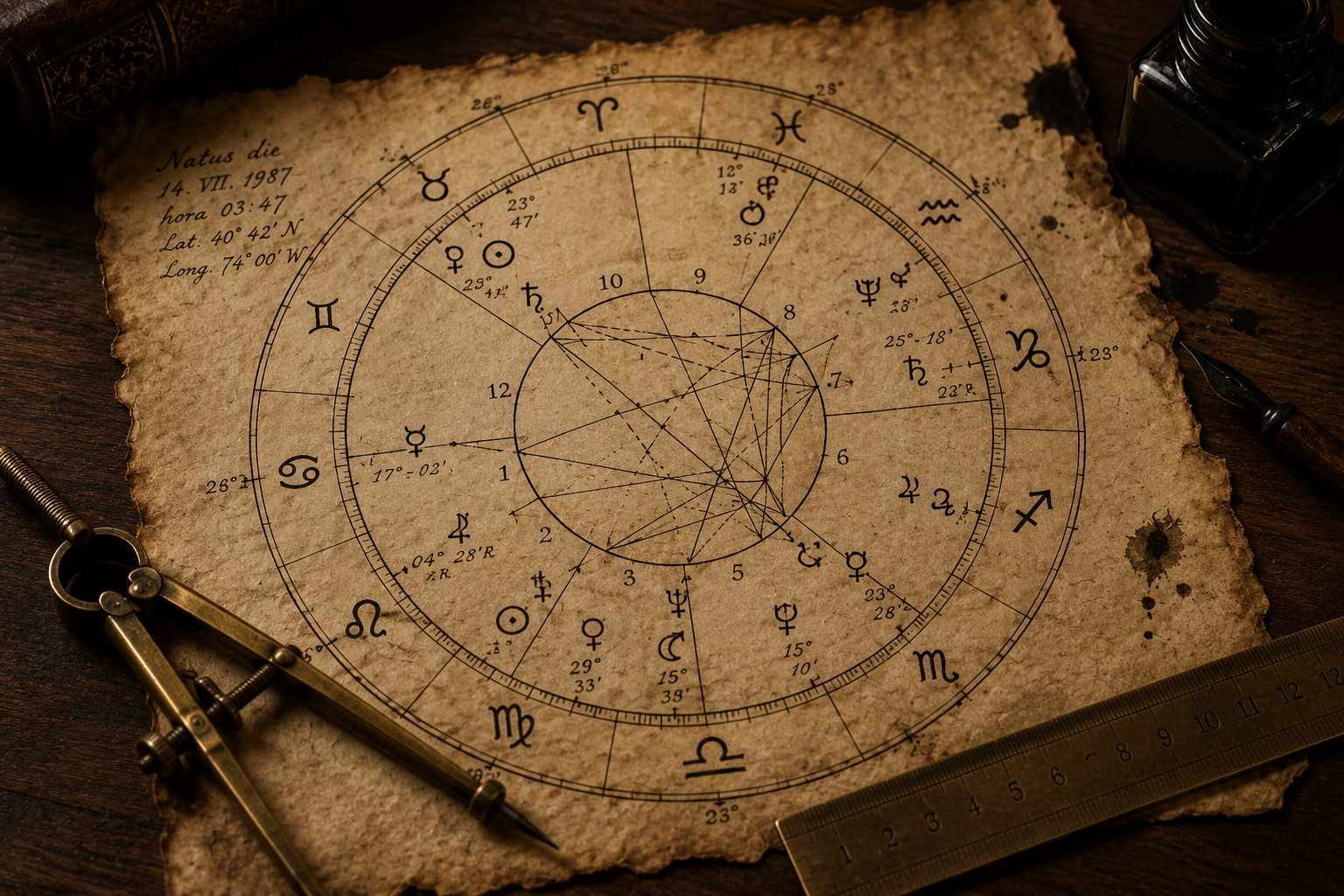
An aspect is the angle formed between two planets measured on the zodiac wheel. When two planets are at 0 degrees of separation it is called a conjunction; at 60 degrees, a sextile; at 90 degrees, a square; at 120 degrees, a trine; and at 180 degrees, an opposition. Each angle has an orb of tolerance: an exact square is 90 degrees, but it also counts if planets are at 87 or 93 degrees, depending on which orb each astrologer uses. Aspects are one of the most important elements of the natal chart because they show how planetary energies communicate with each other.
Flow aspects: conjunction, sextile and trine
The conjunction joins two planets at the same point of the zodiac and merges their energies. It is not necessarily easy or difficult: it depends on which planets are involved. Sun conjunct Jupiter is expansive; Sun conjunct Saturn can be restrictive. The sextile (60 degrees) and trine (120 degrees) are flow aspects: they facilitate the energies of the two planets working in harmony. The trine joins planets of the same element (fire with fire, earth with earth), generating natural compatibility. The sextile joins planets of complementary elements and requires more initiative to tap its potential.
Tension aspects: square and opposition
The square (90 degrees) and opposition (180 degrees) are called difficult aspects, but that label does not mean negative. They generate tension between the energies of the two planets, creating friction but also movement, motivation, and the possibility of integration. The square creates an internal conflict between two impulses competing for the same space; the opposition creates a tug-of-war between two opposite poles of the zodiac. People with many squares in the natal chart are often the most productive because they have a constant internal engine.
Minor aspects: quincunx, semisextile and semisquare
The quincunx (150 degrees) connects two planets in signs that share neither element nor modality, creating a feeling of constant disconnection or adjustment. It is not an easy or dramatically difficult aspect, but rather a subtle friction that demands adaptation. The semisextile (30 degrees) and semisquare (45 degrees) are minor aspects that reinforce dynamics already present in the chart but rarely define main themes. In practice, astrologers prioritize the major aspects for central analysis.
How to read aspects in your own natal chart
When you look at a natal chart you will see lines crossing the interior of the zodiac wheel connecting planets. Red lines usually represent squares and oppositions; blue lines, trines and sextiles. To read an aspect you need to identify the two planets involved, the type of angle they form, and the signs and houses they are in. The interpretation combines the natures of both planets with the type of aspect: Venus trine Jupiter is very different from Venus square Saturn, even though both involve Venus.
Why aspects matter more than individual signs
A planet sign describes how it expresses its energy. The aspect describes whether that energy flows or finds obstacles, whether it works alone or in dialogue with another force. Two people with Mars in Aries can have very different experiences if one has that Mars trine Jupiter (amplified energy, fortunate action) and the other has it square Saturn (restrained energy, frustration in action). Aspects are the nervous system of the natal chart: they connect all elements and determine how they operate together.
The sky in your inbox.
Aspects, transits, techniques: the essentials of astrology, in your email.