How to read a birth chart step by step: beginner's guide
A birth chart has layers: signs, planets, houses and aspects. Understanding how they combine is what turns a list of data into a real reading.
What a birth chart contains
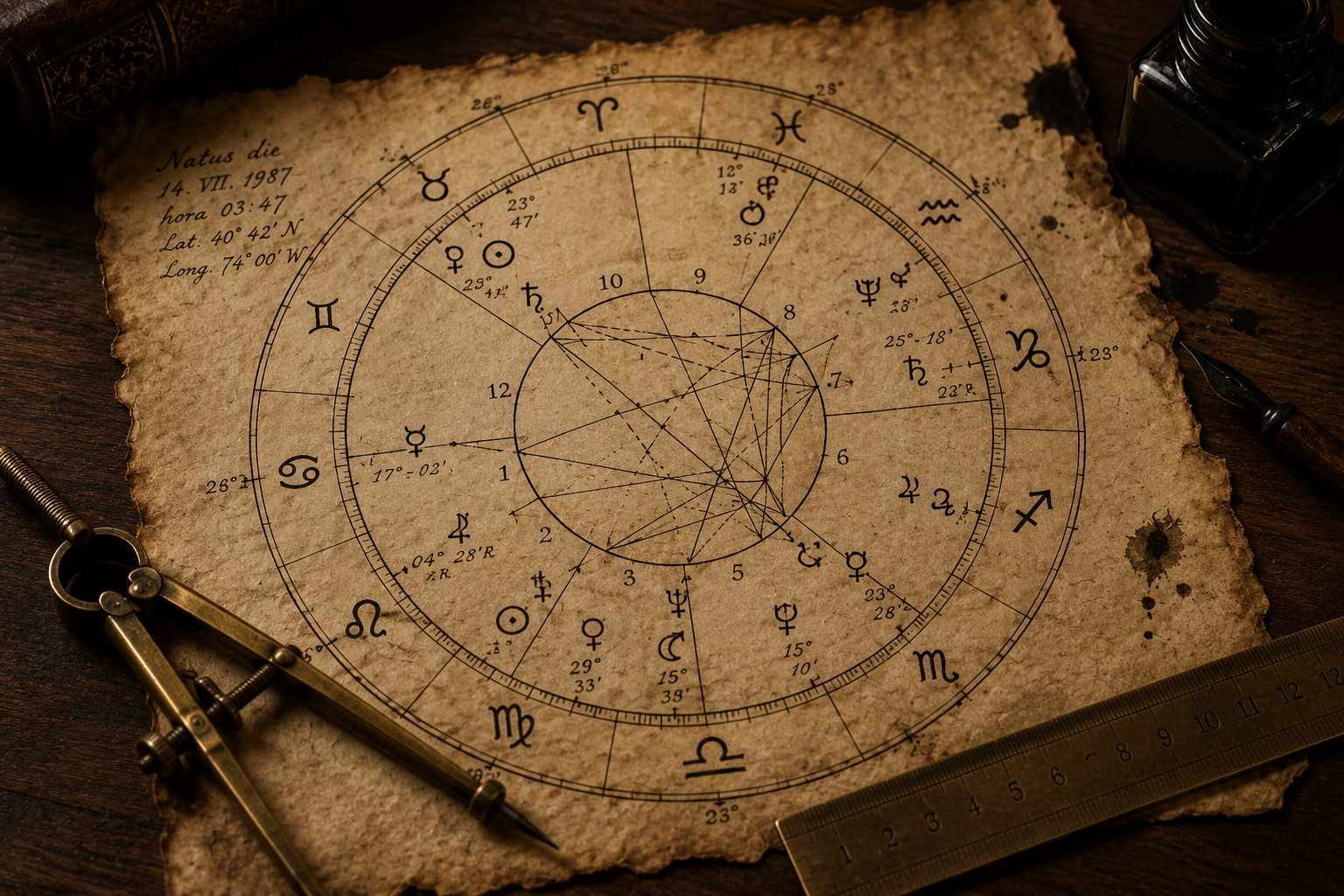
A birth chart is a map of the sky at the exact moment of your birth: which signs occupied each house, which sign each planet was in, and what angles they formed with each other. It has three basic layers to distinguish before you start: signs (the energy or the how), planets (what area of your life each one represents) and houses (the stage where everything happens).
Step 1: identify your Sun, Moon and Rising
The Sun marks your core identity and life purpose. The Moon describes your emotional world and how you react instinctively. The Rising sign, the sign that was rising on the horizon at the moment of your birth, defines the image you project and the filter through which you perceive the world. These three points, known as the big three, give the first overall picture of the chart.
Step 2: place each planet in its sign and house
Each planet rules a specific area: Venus speaks about love and values, Mars about energy and action, Mercury about communication and thinking. Knowing which sign a planet is in tells you how it operates; knowing which house it is in tells you in which area of your life it expresses itself. A Mars in Aries in the 10th house will function very differently from a Mars in Cancer in the 4th house.
Want a detailed reading of your chart?
An astrologer can integrate all the factors into a single coherent reading, not just list them.
Get my birth chartStep 3: read the aspects between planets
Aspects are the angles that planets form with each other. The most relevant ones to start with are the conjunction (0°, fusion of energies), the trine (120°, easy flow), the square (90°, tension and friction) and the opposition (180°, polarity). A planet with no aspects acts in a purer, more isolated way; one with many aspects is highly integrated into the whole chart.
Common mistakes when reading a birth chart
The most common mistake is interpreting each planet in isolation without integrating the context of the complete chart. Another frequent error is ignoring the houses and focusing only on signs. For example, Jupiter in Scorpio can bring expansion through deep transformations or shared finances, depending heavily on which house it occupies. Synthesis is the most difficult skill in astrology.
What an astrologer reads that you do not see
A trained astrologer identifies dominant patterns, recurring tensions and resources you have but are not using. They also read the current transits over your natal chart, the planets in motion activating your natal positions today. This predictive layer explains why the same sun sign can live completely different years depending on the person.
The sky in your inbox.
Interpretations, transits and practical astrology guides every week.