Head line in palmistry: what it says about how you think and decide
The head line is the central horizontal crease on the palm. In palmistry it reveals your mental style, focus capacity and how you process information. Complete guide covering length, curve and special marks.

what is the head line and how to find it on the palm
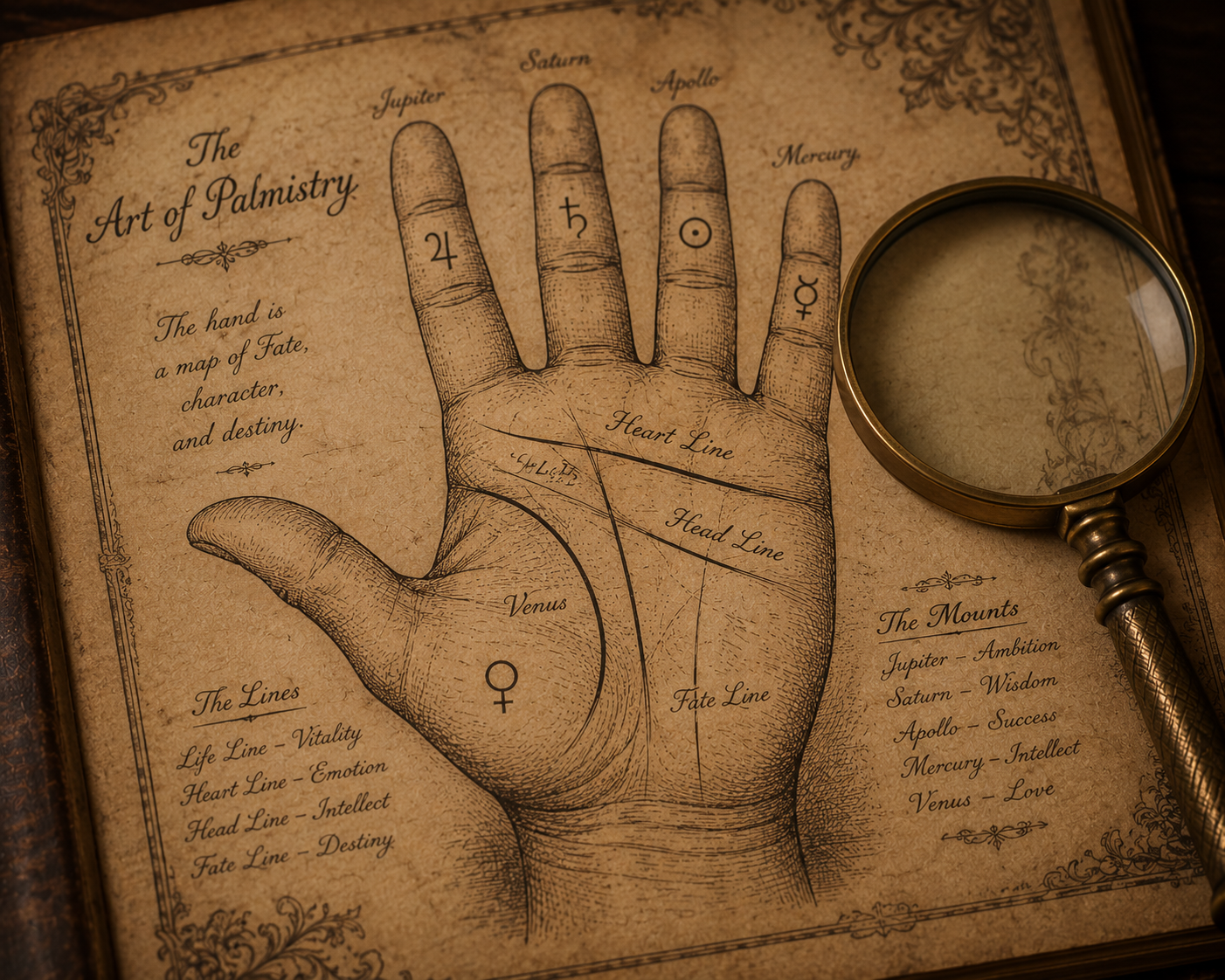
The head line — also called the mental line or intellect line — is the central horizontal crease on the palm, located between the heart line above and the life line below. It runs across the palm from the edge between thumb and index finger toward the center or the percussion of the hand. In Western palmistry it represents mental style: how a person thinks, learns, makes decisions and processes the world. In Chinese tradition it corresponds to the earth element, governing mental stability, concentration and the ability to turn plans into action.
head line length: short, medium or long — what each means
Length is the first indicator of the scope and style of mental processing. Short — does not reach the center of the palm: concrete and practical thinking. The person gets straight to the point without digressing. Excellent for operational tasks and fast execution. Not lesser intelligence — a different processing mode. Medium — reaches the center of the palm: balance between abstract and practical thinking. The most frequent and versatile configuration. Long — reaches the edge of the percussion: broad thinking, deep analysis and long-range vision. Associated with people who have wide-ranging interests or find it hard to close projects because they keep exploring.
curved vs straight head line: intuition vs logic
The direction of the line reveals the dominant reasoning mode. Straight and horizontal: logical, linear, analytical thinking. The person structures information well, plans carefully and prefers concrete data over open interpretation. Curved downward toward the Luna zone: intuition and imagination dominate over logic. Frequent in artists, writers and people with high creative or empathic capacity. The more pronounced the curve, the more marked the imaginative thinking. Mixed — straight at the start and curved at the end: ability to combine logic and intuition depending on context. One of the most adaptable configurations.
marks on the head line: islands, forks and breaks
Marks refine and nuance the overall reading: Islands: ovals on the line. Indicate periods of mental dispersion, difficulty concentrating or cognitive overload. Duration is estimated by the size of the island. Fork at the end: the line splits into two branches at the end. One pointing toward logic, the other toward imagination. Highly sought in palmistry: indicates mental versatility and the ability to think in different modes depending on the situation. Break or interruption: a significant shift in mental style. Can mark a crisis, a career change or a process of intellectual transformation. Not decline — transition. Double line: two parallel head lines. Very rare. Associated with the ability to maintain two mental projects simultaneously without interference.
Head line reading by photo
Upload a photo of your palm and receive a full analysis of your head line alongside all lines and mounts of your hand. No appointment, delivered in 24-48 h.
Upload my palm photohead line and life line: when they share a starting point
The relationship between the head line and the life line at the start of the palm — near the edge between thumb and index finger — provides information about emotional independence in decision-making. Lines joined at the start: the person takes time to develop emotional independence from their family or reference environment. Decisions carry a lot of weight from context and external expectations. Autonomy typically grows over time. Lines separate from the start: marked independence from early on. The person makes decisions autonomously, with little need for external validation. May be impulsive in early years. Lines that separate after a joined segment: independence develops gradually — the most common evolution, associated with steady personal growth.
how to read your head line in a palm photo
To get a precise reading of the head line by photo, these details make the difference: 1. Soft side lighting: illumination from one side makes lines cast shadows and appear more clearly, especially the forks at the end. 2. Palm open and relaxed: neither fully extended nor closed. The natural open-hand position shows lines as they truly are. 3. Sufficient resolution: a photo of 8 MP or more allows you to see fine marks like small islands and double lines. 4. Send both hands: comparing the head line in both hands reveals how much of the innate potential has developed in real life.
Palmistry in your inbox.
Weekly analysis of palm lines, mounts and special marks. Straight to your inbox, no spam.