Full moon and dreams: what happens while you sleep during a full moon
Many people report more intense dreams or worse sleep during a full moon. What does science say? What do traditions say? And what can you do with that. All here.
Does the full moon affect dreams? What science says
In 2013, a study published in Current Biology by Cajochen et al. showed that during a full moon, participants took longer to fall asleep, spent less time in deep sleep, and reported worse rest quality, even under laboratory conditions without windows. The effect was modest but reproducible. Subsequent studies have had contradictory results: some confirm the pattern, others do not replicate it. What does seem clear is that the full moon does not affect everyone equally: some people have greater sensitivity to changes in ambient light than others.
Most common types of dreams during the full moon
What people who keep dream journals during lunar cycles most frequently report: dreams with more emotional charge than usual, greater presence of people from the past, dreams in which difficult decisions are made, and a more vivid or cinematic texture. This is consistent with the reduction of deep sleep (which is more restorative but less active in images) and the relative increase of REM sleep (where most narrative dreams occur). More REM, more vivid dreams. Less physical rest, more memorable dream activity.
What traditions say about the full moon and dreams
In most shamanic traditions and popular spirituality, the full moon is a period of greater permeability between the conscious and unconscious world. It is not an arbitrary belief: it reflects the observation that the full moon coincides with greater activity, less sleep, and more dreams remembered. In the Jungian tradition, the moon is associated with the collective unconscious and feminine archetypes. In many cultures, the full moon was the time to make requests, close cycles, or interpret dreams with special attention.
New moon vs full moon: what you dream in each phase
The new moon corresponds to a period of greater nocturnal darkness and, generally, deeper and less dream-active sleep. New moon dreams tend to be more diffuse, less narrative, harder to remember. The full moon produces the opposite effect: more nocturnal light, more fragmented sleep, more REM, more story-driven dreams. If you keep a dream journal, recording the lunar phase alongside each entry can reveal personal patterns that do not exactly match the average, which is also useful information.
How to use the full moon to work with your dreams
If you know that during full moon you sleep worse and dream more, you can prepare: go to bed 30 minutes earlier than usual to compensate for the reduction in deep sleep, keep a notebook by the bed to write down what you remember upon waking, and review those dreams more carefully than usual. Many people who work intentionally with dreams reserve the full moon for asking specific questions before sleep: unresolved problems, pending decisions, relationships that need attention. The enhanced dream intensity of the period facilitates clearer responses.
Have a recurring dream or one you cannot get out of your head?
Tell me the dream and how it felt. I return symbols, connection to your life, and a concrete piece of advice.
Interpret my dreamHow to keep a lunar dream journal
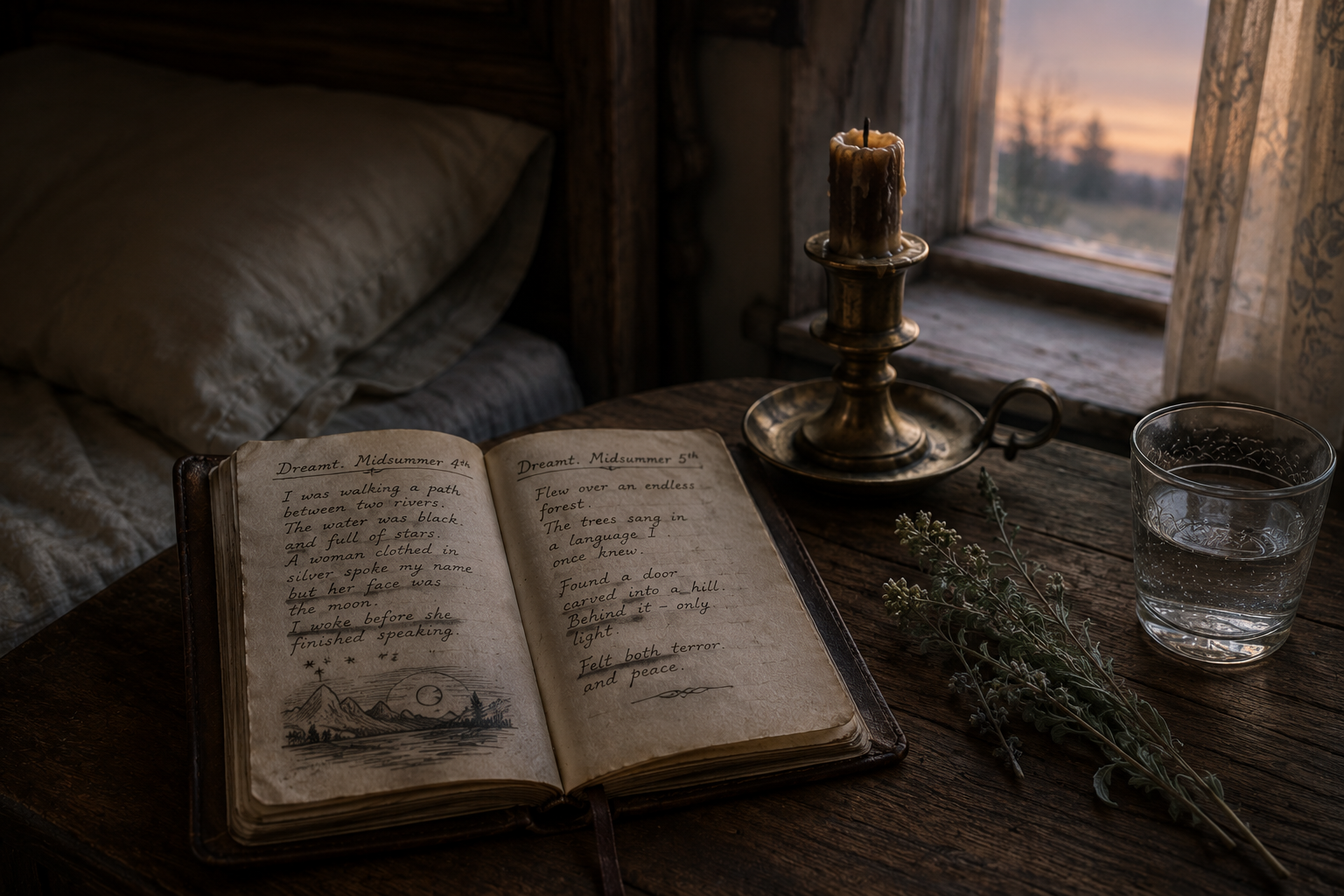
The simplest method: a notebook by the bed, writing as soon as you wake up (before looking at your phone), writing the date and lunar phase, and describing the dream in present tense. No need to interpret it right away: the record is what matters. After three or four complete lunar cycles (about three months), you will have enough data to see if there is a real difference in the quality or content of your dreams depending on the phase. That self-knowledge is worth more than any generic claim about the moon.
The invisible in your inbox.
Dreams, moon, aura and more, every week without noise.