Fingers in palmistry: length, shape and what each one reveals
Complete palmistry guide on fingers: length, fingertip shape, index, ring, little and thumb. What each one reveals.

fingers in palmistry: beyond the main lines
Classical palmistry pays as much attention to fingers as to the main lines. Fingers reveal how energy expresses itself outward: how a person acts, communicates, makes decisions and structures their life. Four dimensions are analyzed: the relative length of each finger, fingertip shape, flexibility and knuckles. A finger analysis alone already gives a clear character profile; combined with the main lines, the reading becomes much more precise.
finger length in palmistry: long fingers, short fingers and the ratio to the palm
Length is measured by comparing the middle finger to the palm: if the middle finger is equal to or longer than three-quarters of the palm length, the fingers are considered long. Long fingers indicate analytical thinking, attention to detail and a tendency toward introspection. Short fingers speak of quick intuition, global vision and a preference for action over reflection. The ratio between fingers also matters: a ring finger longer than the index is associated with creative orientation and risk-taking; an index longer than the ring finger, with greater leadership orientation and structure.
the four fingers and the thumb: individual meaning in palmistry
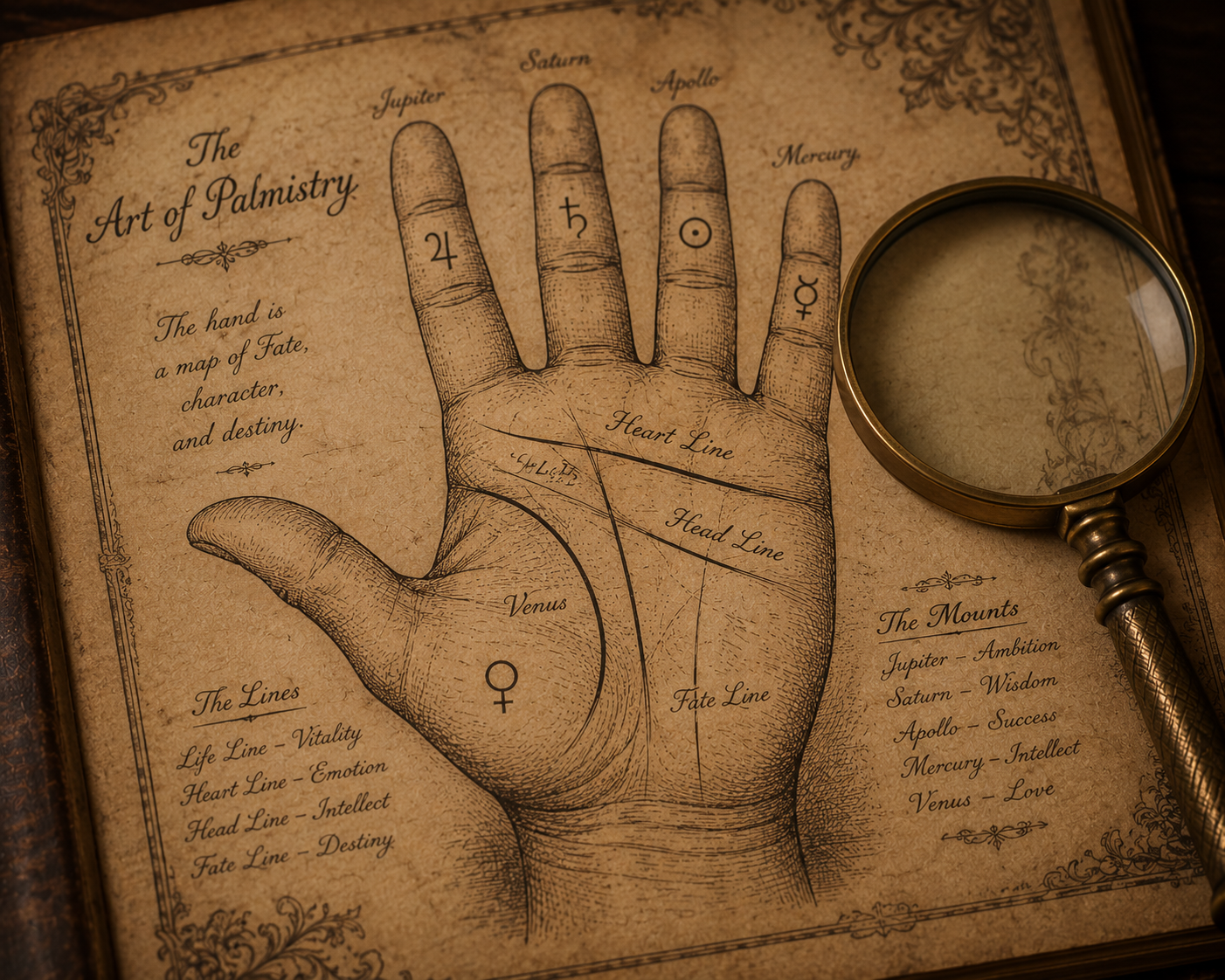
The thumb represents will and logic: a long, flexible thumb signals adaptability and strength of character; rigid and short, stubbornness. The index finger (Jupiter) speaks of ambition and self-confidence. The middle finger (Saturn) shows responsibility, structure and relationship with rules. The ring finger (Apollo) reflects creativity, aesthetic sense and social orientation. The little finger (Mercury) indicates communication ability, persuasion and intuitive handling; when notably short — not reaching the upper crease of the ring finger — communication may be a development area.
Palm reading with a photo of your hand
We analyze lines, mounts and fingers from a photo of your palm. No appointment, no waiting.
Upload my hand photofingertip shape in palmistry: square, conic, spatulate and mixed
The square tip indicates practicality, order and concrete thinking. The conic or rounded tip points to artistic sensitivity, intuition and emotional receptivity. The spatulate tip — wider at the end than at the base — speaks of physical energy, originality and a taste for experimentation. Few people have all fingers the same: a combination is typical, and that mix defines the profile in a nuanced way. The finger with the most different tip from the rest usually marks the area of greatest personal singularity.
knuckles and finger flexibility: additional detail in the reading
Prominent knuckles, forming a visible double row, are associated in palmistry with analytical thinking and a need to process information before acting. Smooth-knuckled fingers indicate intuitive fluency and quick thinking. Flexibility matters too: fingers that bend backward easily signal adaptability and openness to change; rigid ones, a more fixed worldview. The natural inward curve of fingers toward the little finger is interpreted as intense social orientation.
how to photograph your hand to include fingers in the palmistry reading
For a reading that includes the fingers, the photo must show the open palm with fingers extended naturally — without forcing them apart or together. Light should illuminate evenly, without shadows hiding the joints. It is recommended to photograph both hands: the non-dominant hand shows the baseline potential; the dominant hand, how that potential is being actualized. A sharp image from around 30-40 cm away is sufficient to read length, tip shape and knuckles.
Your reading in your inbox.
Palmistry, Mian Xiang and aura reading guides. Once a month, without overload.