Chinese vs Western palmistry: differences and how the lines are read
Complete comparison of Chinese and Western palmistry: line names, which hand to read, mounts, origins and when to use each tradition.

two palmistry traditions: different origins, different goals
Western palmistry, rooted in ancient Greece and European hermeticism, focuses on the hand lines as a reflection of the individual psyche and life. Chinese palmistry, integrated into traditional Chinese medicine, interprets the hand as part of a broader energetic diagnosis: meridians, qi, and ba zi (Chinese astrology) complement the hand reading. Both traditions reach similar conclusions by very different routes.
how the lines are named: Western hand vs Chinese hand
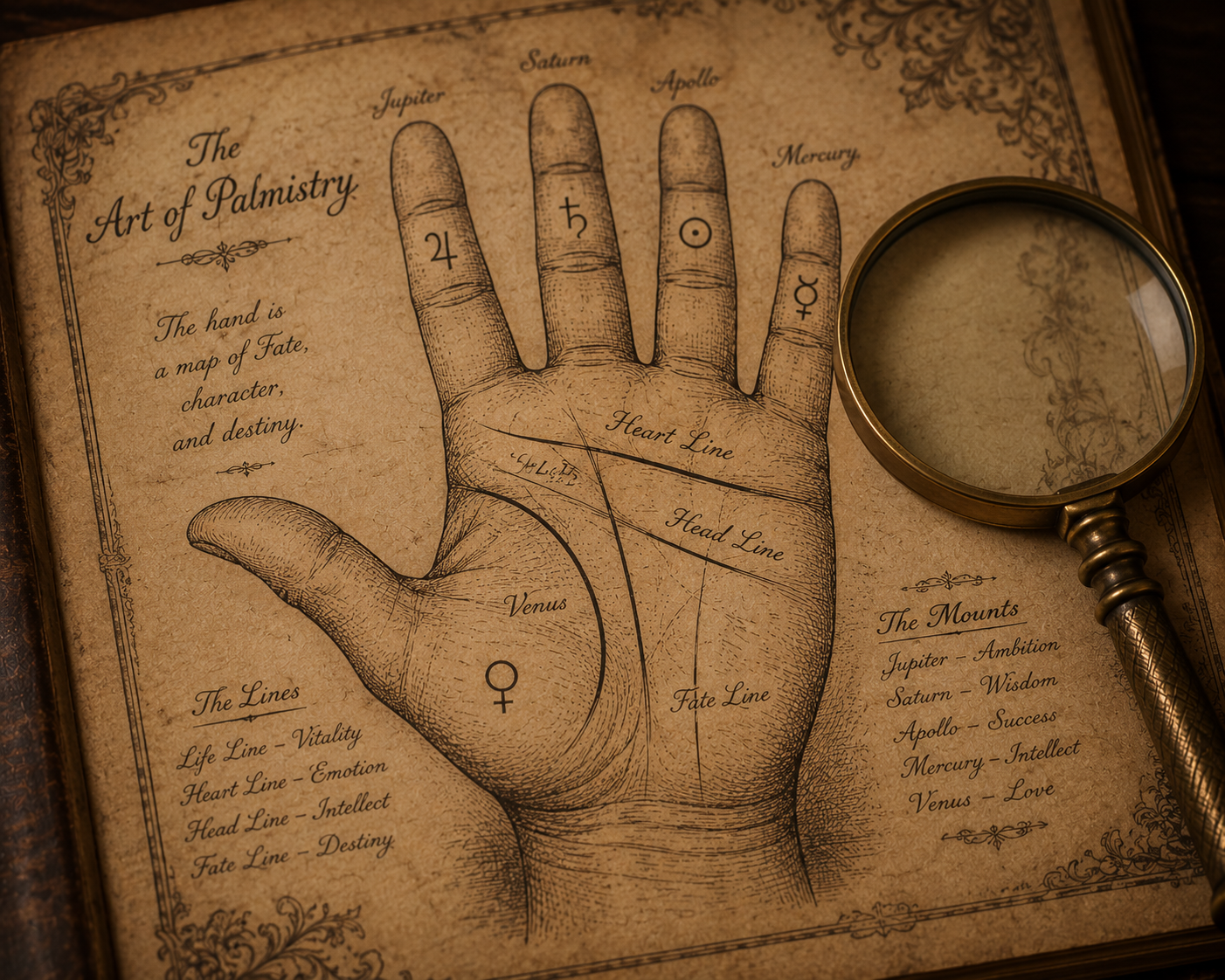
In the Western tradition the four lines are called life, head, heart and fate. In the Chinese tradition those same lines have names reflecting their energetic orientation: the life line is associated with vital qi and physical constitution; the head line with the hun spirit (mental soul); the heart line with the shen spirit (emotional mind). Fate, in Chinese reading, carries the most philosophical weight: it speaks of mission, not just career.
right vs left hand: a debate with different answers in each tradition
West: the dominant hand reflects lived life, the non-dominant shows inherited potential. China: the right hand represents yang (exterior, world, action); the left represents yin (interior, emotions, intimate relationships). For a complete Chinese reading both hands are compared to see whether there is balance between a person's inner and outer world.
Get your personalised palm reading
Upload a clear photo of your open palm and receive a complete analysis of your lines and mounts, drawing from both perspectives.
Upload my photothe mounts of the hand: planets in the West, elements in China
In Western palmistry the mounts are named after planets: Jupiter, Saturn, Apollo, Mercury, Venus, the Moon, active Mars and passive Mars. Each planet brings its classical symbolism. In the Chinese tradition the same mounts are read in relation to the five elements (wood, fire, earth, metal, water) and the eight trigrams of the I Ching. A prominent mount in Western reading speaks of a character trait; in Chinese reading it also speaks of how qi flows in that area of the body.
which tradition is more useful and when to use them
Neither is better. The Western tradition is more accessible as an entry point: direct nomenclature, a clear relationship between line and life area. Chinese palmistry is deeper if you already know something about TCM or the I Ching, and is especially useful for integrating the hand reading with the ba zi or birth date. In practice, many contemporary readers combine both: naming the lines in Western terms and adding Chinese energetic reading to add nuance.
lines that one tradition sees and the other ignores
Chinese palmistry pays close attention to the lines of the fingers and the second phalanx of the thumb, something Western tradition tends to treat as secondary. On the other hand, Western palmistry has more detailed nomenclature for minor lines: the sun line (Apollo), the intuition line, the marriage line. Chinese palmistry tends to integrate those secondary lines within an overall analysis of the energetic field of the hand.
More palmistry in your inbox.
Guides, meanings and differences between traditions. No spam.