Birth chart without birth time: what you can and can't know
Without a birth time you can still read the Sun sign, Moon sign, Mercury, Venus, Mars and outer planets. What's missing are the houses, rising sign, and Midheaven. Here's what changes and how to compensate.
What information a birth chart needs to be complete
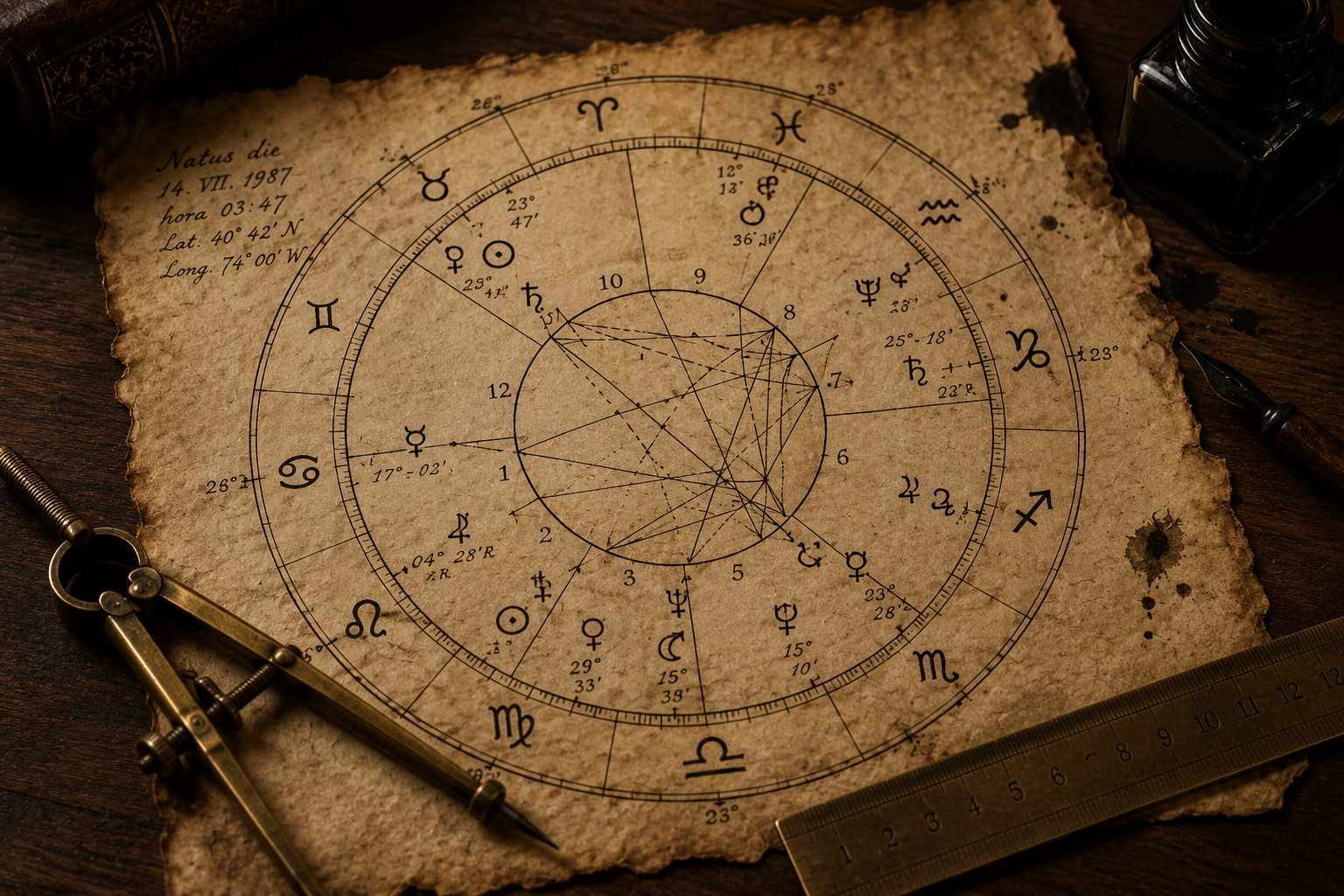
A standard birth chart requires three pieces of data: date of birth, place, and exact time. The time determines the rising sign, the twelve houses, and the Midheaven — the personal backbone of any interpretation. Without it, house calculations are impossible and the rising sign cannot be defined. The planets, however, can be calculated with just date and place: the Sun, Moon, Mercury, Venus, Mars, and outer planets all land in their natal signs with day-level or near-arc-minute precision.
What you lose without a birth time
Without a birth time you cannot calculate the rising sign, the twelve astrological houses, or the Midheaven. This means you cannot know in which life area each planet operates: Saturn in the 10th house affects career; Saturn in the 4th, family. The exact position of the Moon is also uncertain when it changes signs on the birth day — the Moon moves through a full sign in about two and a half days.
What a birth chart without a time still reveals
With only a birth date and place you can read the Sun sign, and the signs of Mercury, Venus, Mars, Jupiter, Saturn, Uranus, Neptune, and Pluto. You can also calculate aspects between planets (trines, squares, oppositions, conjunctions) because these depend on zodiac position, not houses. A time-unknown chart is still useful for character analysis, relationship patterns, vocation, and the long cycles marked by outer planets.
Your birth chart — even without an exact time
We work with known or unknown birth times. If you do not have the data, we will explain how to try to recover it and what the reading includes in each case.
Order my birth chartHow to find your birth time
The first option is the birth certificate or hospital records, where in many countries the time of delivery is registered. In the US, long-form birth certificates often include the time. If documents are not available, close family — especially mothers — are the next source. Some hospitals keep delivery records with the exact time; requesting a copy of the admission report can solve the problem.
Birth chart rectification: when it is worth it
When the birth time is approximate or completely unknown, there is a technique called natal rectification. It involves cross-referencing key biographical events (marriages, divorces, deaths, moves, career changes) with the transits and directions for each possible time, until the one that best fits the life story is identified. This is a technical process requiring an experienced astrologer. It is not worth it for a one-off general reading, but it is if you plan to use the chart as a long-term self-knowledge tool.
The Moon as a special case: verification needed
The Moon is the only planet that can change signs on the same birth day. If you were born when the Moon was transitioning between two consecutive signs, you need at least a morning or afternoon estimate to pin down the lunar sign. In many cases the astrologer will present both possible signs and assess which better describes the emotional profile. An honest reading will flag this margin rather than assigning a lunar sign without evidence.
The sky in your inbox.
News, guides, and transit analysis straight to your email.