The 12 astrological houses: what they are and what life area each one represents
The astrological houses divide the natal chart into 12 life areas. Each covers a specific domain: identity, money, communication, family, love, work, transformation and more.
What astrological houses are and how they are calculated
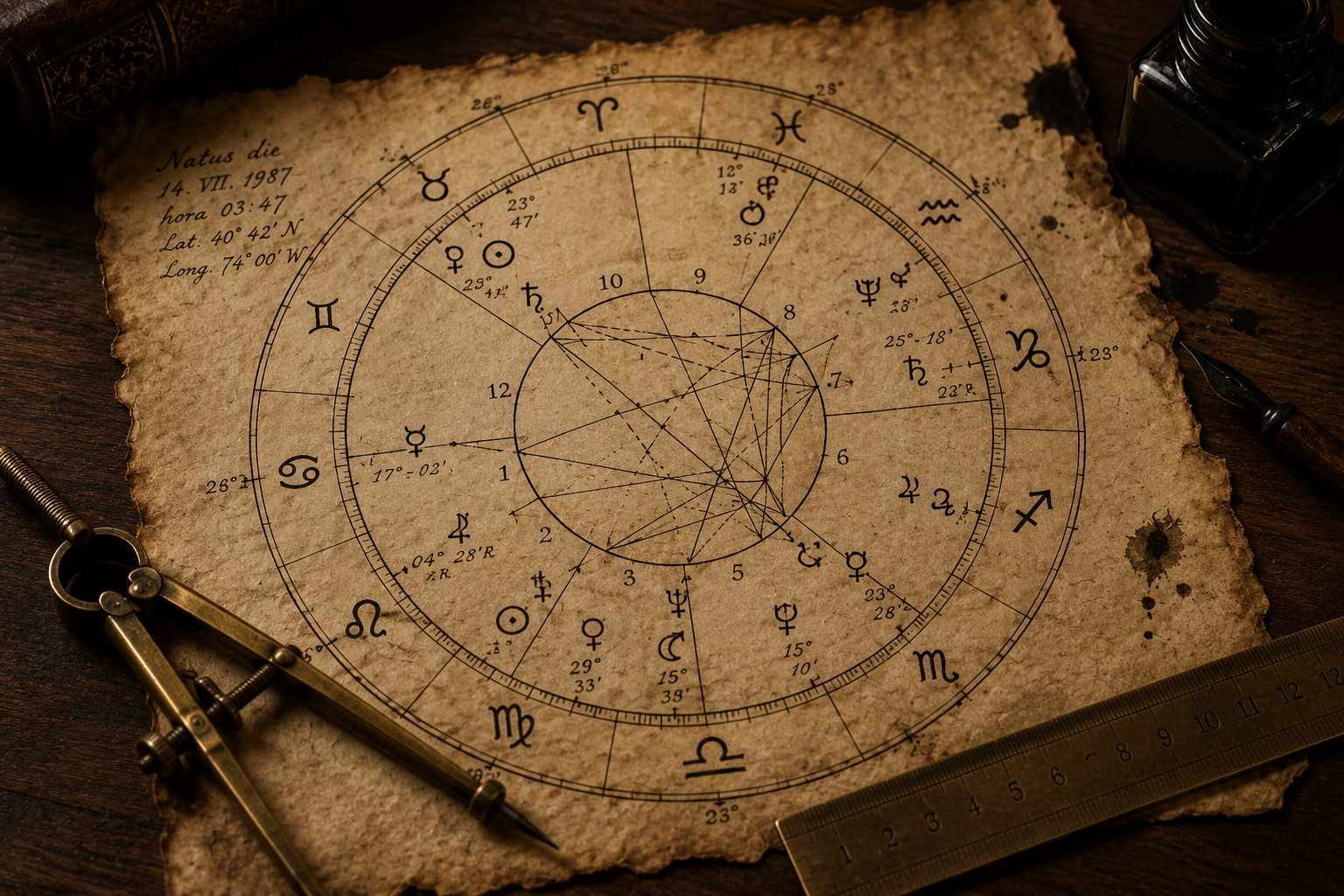
The astrological houses are the 12 divisions of the natal chart that represent different areas of life. They are calculated from the birth time and place: the Ascendant marks the beginning of the first house, and the rest are distributed according to the house system used — the most common are Placidus, Koch and Whole Sign. Unlike signs, houses do not have a fixed duration; they can be large or small depending on birth latitude and the system applied.
Houses 1 to 6: the personal and internal world
House 1: the self, the body, physical appearance and how you present to the world. House 2: personal resources, earned money, personal values and material goods. House 3: communication, thought, siblings, immediate environment and short trips. House 4: home, family of origin, roots and the private sphere. House 5: romantic love, children, creativity, pleasure and self-expression. House 6: daily health, routines, daily work, service and habits.
Houses 7 to 12: the relational and collective world
House 7: partner, contracts, one-to-one relationships and what we project onto others. House 8: transformation, death, inheritances, debts, sexuality and what is shared with others. House 9: philosophy, long travel, higher education, spirituality, law and foreign places. House 10: career, public recognition, Midheaven and professional reputation. House 11: friendships, groups, community, collective projects and ideals. House 12: the unconscious, karma, retreat, hidden enemies, institutions and deep spirituality.
Angular, succedent and cadent houses
Houses are grouped into three categories. Angular (1, 4, 7, 10): the most powerful, coinciding with the four cardinal points — Ascendant, IC, Descendant and Midheaven — and any planet in them has a direct and visible impact. Succedent (2, 5, 8, 11): stabilize and consolidate the energy of the angular houses. Cadent (3, 6, 9, 12): more internal and reflective, related to adaptation and learning.
What it means to have planets in a house
When a planet occupies a house, the activity of that life area is marked by the nature of that planet. Jupiter in the 2nd house expands resources; Saturn in the 7th introduces restrictions or lessons in relationships. The more planets in a house, the more emphasis that area has in the person's life. A house with several planets — a house stellium — is an area of great activity and complexity.
What it means to have an empty house in your natal chart
An empty house does not mean that life area is irrelevant. It simply means no natal planet occupies that space. The area is still active through the sign that occupies it and the planet that rules that sign — the house ruler — which may be elsewhere in the chart. Empty houses are common and do not indicate lack: most natal charts have several.
Analyze your houses with a complete natal chart reading
Sun, Moon, Rising, planets and all 12 houses interpreted. Delivered in 72 hours.
Order my birth chartThe sky in your inbox.
Guides, transits and applied astrology every month.